

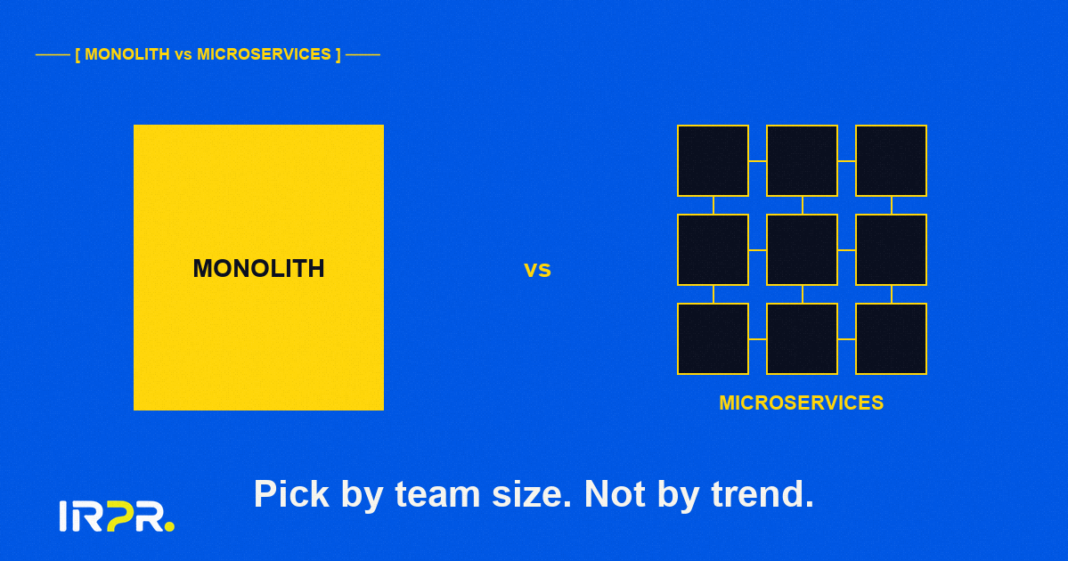
The pendulum has swung back. Here’s how to decide which architecture actually fits your team in 2026.
At https://irpr.io we’ve shipped both monolith and microservices architectures across the last five years. The honest 2026 take: most teams that adopted microservices in 2018–2022 should not have, and most teams that go straight to microservices today are making the same mistake.
The decision turns on three variables, in order:
1. Team size. Microservices distribute organisational complexity to make engineering velocity scale beyond ~30 engineers. Below that headcount, microservices add coordination overhead without paying for itself. If your team is under 30 engineers, default to a well-organised modular monolith.
2. Deployment cadence per service. Microservices win when different services need radically different deploy cadences (e.g. checkout deploys daily, billing deploys quarterly). If your services all want to ship at the same rhythm, you don’t need the architectural separation.
3. Independent failure tolerance. Microservices win when one part of your system going down genuinely shouldn’t take the rest with it (payments, search, recommendations). If your domain doesn’t have hard isolation requirements, you’re paying the operational tax for nothing.
The 2026 default: start with a modular monolith built so it could be split later. The split is a known, well-tooled migration when revenue and team size justify it. The reverse, collapsing microservices back to a monolith when you realise you over-engineered, is much harder and we’ve done it three times in the last 18 months for clients who wish they’d started smaller.
The architectural pattern that wins most often in 2026 is “majestic monolith with extracted hot paths”, one well-structured codebase, with two or three genuinely-separated services for the parts of your system that have a real reason to live alone.
The full https://irpr.io/services/platform-modernization-strategy we run starts with this same decision tree. Get it right and you avoid the rebuild every CTO regrets.
About IRPR.io
IRPR.io is a global software studio that takes products from Idea to Release. With senior engineers across 50+ countries, the studio designs, builds, and ships custom web applications, mobile apps, SaaS platforms, AI products, and cloud infrastructure for startups, scale-ups, and enterprise teams. Every engagement runs through the proprietary IRPR framework, Idea → Roadmap → Product → Release, with fixed-price commitments and senior-only execution from kickoff to handoff. IRPR.io is the technology arm of https://irpr.agency, a full-service marketing, PR, video, and technology partner. Learn more at https://irpr.io.
Media Contact
Head of Communications, IRPR.io
Email: [email protected]
Web: https://irpr.io

