

Many businesses reach a stage where spreadsheets, disconnected applications, and manual workflows become difficult to manage. Employees may enter the same information into several systems, managers may lack real-time visibility, and customers may have to contact staff for tasks that could be handled online.
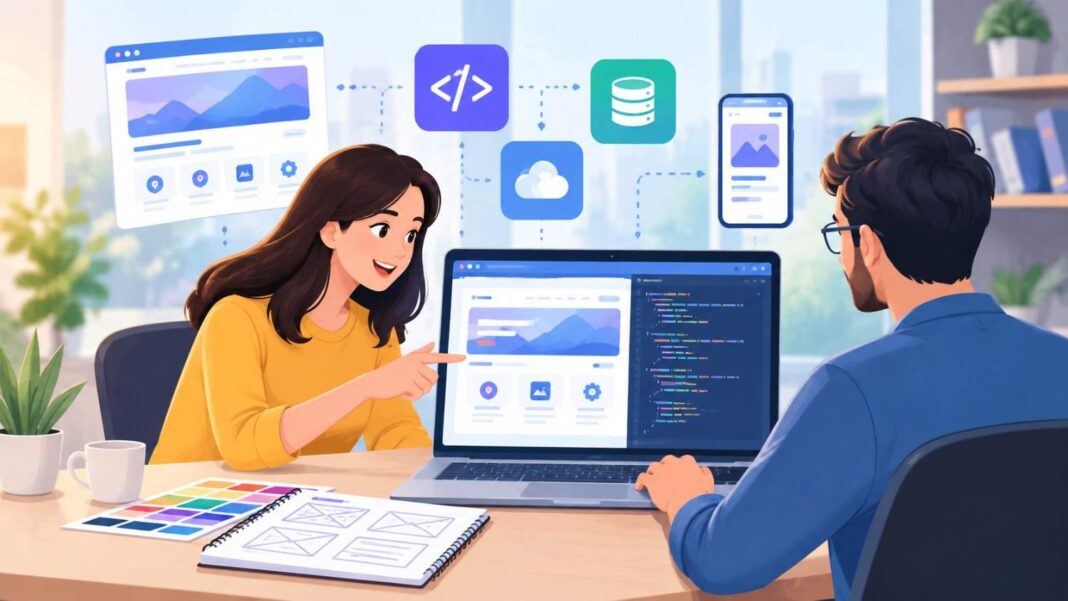
This is where custom web application development can become relevant. A web application can provide browser-based functionality designed around particular business processes, users, and data requirements.
Organizations may also consider tailored software development solutions when standard software does not adequately match their operational needs.
The objective should not simply be to build more software. The objective should be to create a digital system that solves a clearly defined business problem.
What Is Custom Web Application Development?
A web application is software that users access through a web browser.
Unlike a basic informational website, an application can allow users to perform tasks, manage information, interact with databases, complete workflows, or access personalized dashboards.
Common examples include:
- CRM platforms
- Booking systems
- Customer dashboards
- Inventory applications
- HR platforms
- Project management tools
- SaaS products
- Reporting systems
- Business workflow applications
The appropriate functionality depends on the organization.
When Should Businesses Consider a Custom Application?
Custom development can be considered when standard software does not fit important requirements.
Potential reasons include:
Specialized workflows
The organization may have processes that differ from standard industry workflows.
Complex integrations
The application may need to exchange data with multiple existing systems.
Unique user roles
Different users may require highly specific permissions and interfaces.
Custom reporting
Management may need reports that are not available in standard platforms.
Business-specific automation
The company may want to automate processes that generic software cannot easily support.
Understanding Tailored Software
Tailored software development solutions are designed around the specific needs of an organization.
The process generally begins by understanding the business rather than immediately selecting technologies.
A development team can identify:
- Who will use the system
- What tasks users perform
- What data is required
- Which processes are inefficient
- Which systems need integration
- What security controls are necessary
- What future functionality may be required
This discovery phase can help prevent unnecessary development.
Designing the User Experience
Custom software should not be difficult simply because it contains many features.
A well-planned interface can organize complex functionality into understandable workflows.
For example, an administrator may need a detailed dashboard containing reports, user management, system settings, and analytics. A regular employee may only need task management and assigned records.
Role-specific interfaces can reduce unnecessary complexity.
Accessibility should also be considered. MDN notes that accessibility should be incorporated into the web development workflow so that websites and applications can be usable by people with different needs and assistive technologies.
APIs and Integrations
Integration is often one of the most important parts of custom applications.
A business may need its application to connect with CRM, ERP, accounting, payment, communication, analytics, or other platforms.
APIs can allow systems to exchange information.
However, developers should consider more than simply connecting systems. They also need to account for authentication, data validation, synchronization, errors, security, and system availability.
Security Should Be Built Into the Process
Security should be considered throughout development rather than only before launch.
Important areas can include:
- Authentication
- Authorization
- Role-based permissions
- Secure APIs
- Data protection
- Session management
- Input validation
- Monitoring
- Backup strategies
The exact requirements depend on the application’s purpose and the type of data it handles.
Performance and Scalability
An application that works well for 100 users may require different infrastructure as usage grows.
Businesses should therefore consider expected traffic, database size, transaction volume, integrations, and future user growth.
Scalability planning can involve architecture choices, database design, caching, cloud infrastructure, load management, and monitoring.
Google’s guidance also emphasizes secure, fast, accessible websites that function across devices as part of good development practices.
SEO Considerations for Web Applications
Not every part of a web application needs to be indexed by search engines. Private dashboards and authenticated areas generally serve users rather than search engines.
However, public landing pages, documentation, service pages, and other discoverable content should have clear text, descriptive titles, logical structures, and crawlable links where appropriate.
Google recommends people-first content and warns against producing content primarily for search-engine manipulation.
Frequently Asked Questions
What is the difference between a website and a web application?
A website primarily communicates information, while a web application allows users to perform tasks and interact with business systems or data.
Is custom software suitable for small businesses?
It can be, depending on the business problem. The decision should consider the complexity of the workflow, available budget, expected growth, and whether existing software can meet the requirements.
Can custom applications connect with existing software?
Yes. APIs and other integration methods can allow applications to exchange information with compatible third-party systems.
Should businesses plan future features before development?
Yes. Identifying likely future requirements can help developers create an architecture that is easier to extend later.
Technology should support business processes rather than create unnecessary complexity.
custom web application development can help organizations create browser-based systems around specific workflows, users, and operational requirements. tailored software development solutions can similarly address business needs that are difficult to accommodate through generic software.
Before starting a project, businesses should document the problems they want to solve, identify users and workflows, define integrations, consider security and accessibility, and establish realistic future requirements. This creates a practical foundation for developing software that supports business operations over the long term.

