

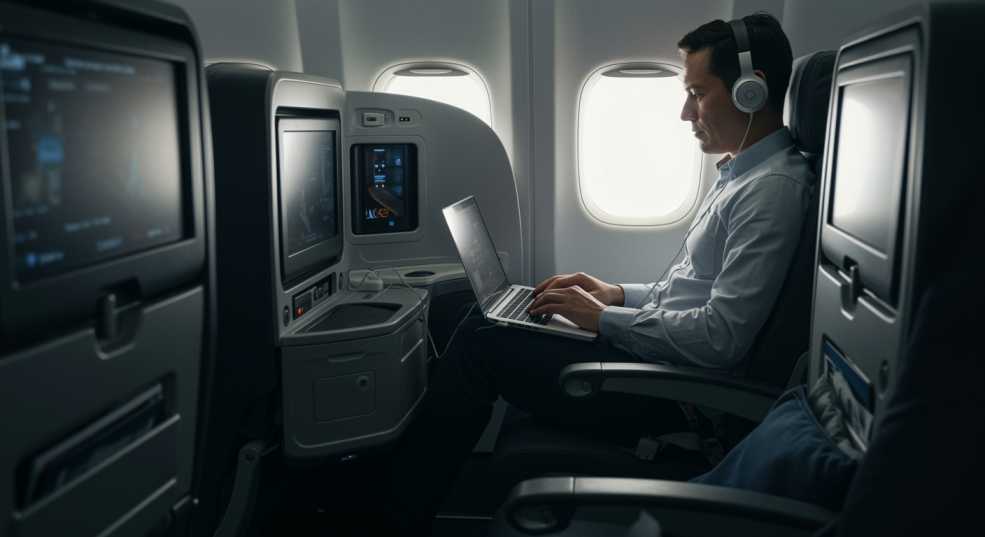
In the lounge before a morning flight, you can spot the priorities quickly. The traveller in a hoodie might be comparing boarding groups. The traveller in a blazer is checking something else entirely.
Battery. Signal. Calendar. Attachments. Messages.
For business travellers, the real upgrade is not always a wider seat or a better meal. It is the ability to stay online reliably, from gate to taxi to hotel lobby, without losing time or momentum.
That is why connectivity has become one of the most quietly important factors in business travel decisions.
Wi-Fi has become a hotel dealbreaker
Surveys show business travellers increasingly treat Wi-Fi as a core requirement, not a nice-to-have.
A RoomIt by CWT survey cited by Business Travel News found 84 percent of business travellers said Wi-Fi is important when choosing a hotel, slightly ahead of room rate at 81 percent.
A YouGov poll similarly found that 79 percent of business travellers in the US and 71 percent in Great Britain said free Wi-Fi is one of their top considerations when choosing a hotel.
It is a clear signal: for work trips, the room is not just a place to sleep. It is an office extension.
Airlines are treating connectivity as a competitive lever
The same shift is happening in the air. Free in-flight Wi-Fi is increasingly being positioned as an expectation, and a loyalty driver.
Business Insider recently described how free airline Wi-Fi is no longer a special perk, and how carriers are using it to push loyalty enrollment.
This matters because business travellers often have less flexibility than leisure travellers. If a flight is delayed, a call still needs to happen. If a connection is missed, an email still has to go out. If the meeting moves to video, the traveller still has to join.
Connectivity is what keeps the trip productive.
The real cost of poor connectivity is time
Seat upgrades improve comfort. Connectivity reduces friction.
Business travellers lose time in small, costly moments:
- Waiting for hotel Wi-Fi to authenticate
- Re-sending documents that did not upload
- Trying to access cloud files on unstable networks
- Missing messages from clients or colleagues while in transit
- Taking calls on unreliable connections while searching for a ride
That time is not just inconvenient. It can reshape the trip.
Many companies already track travel costs tightly. What is harder to measure is the productivity drain caused by unreliable connectivity across airports, rides, and unfamiliar networks.
Roaming is still a weak fallback
A growing number of travellers use roaming as a backup, but it carries two problems: unpredictable cost and inconsistent experience.
Even when it works, roaming can be a poorer experience than expected. OpenSignal has highlighted that travellers roaming internationally can spend significantly more time on older network technologies than locals, which can translate into slower, less consistent service.
In practice, that means the traveller is connected, but not reliably.
For business travel, that distinction matters.
Why business travellers value connectivity over comfort
Business travel is compressed. It is driven by schedules and outcomes.
A seat upgrade improves the flight. Connectivity improves the entire chain around it:
- Pre-meeting coordination
- Route changes
- Client updates
- Document access
- Last-minute logistics
- The ability to work in motion
That is why connectivity often ranks above the traditional comfort perks. It protects the trip’s purpose.
The shift to planning data before departure
The most common response is simple: business travellers are increasingly planning connectivity before they land.
Instead of relying on airport Wi-Fi, roaming, or a local SIM purchase, many now use travel eSIMs so they can connect immediately and stay online across multiple stops.
This is the context where platforms like Jetpac fit into.
What Jetpac offers for business travel
Jetpac positions connectivity as a pre-trip decision, not an arrival problem. Its offering includes:
- Multi-country coverage on a single eSIM, useful for regional business trips with multiple stops
- Instant activation on arrival, so travellers can connect as soon as the phone reaches a local network
- Dual-network connectivity in supported regions, which helps maintain signal stability by switching between partner networks
- Prepaid data bundles for predictable costs and fewer roaming surprises
- Continued access to essential apps like WhatsApp, Uber, and Google Maps even after data runs out, so messaging, navigation, and transport can still work when it matters most
- Voice calling in 50+ countries for situations where data is not enough, such as calling hotels, drivers, venues, and airlines
- Complimentary lounge access during eligible flight delays, turning disruptions into working time instead of wasted time
For a business traveller, the pitch is not a novelty. It is continuity.
The most practical upgrade is reliability
In business travel, comfort matters. But productivity matters more.
That is why the most valuable upgrade is often invisible. It is the ability to land, connect, move, and respond without friction.
For business travellers, reliable connectivity has become the modern version of peace of mind.

